A pre-Civil War vessel, and the afterlife of an object that outlived its set:
The short version
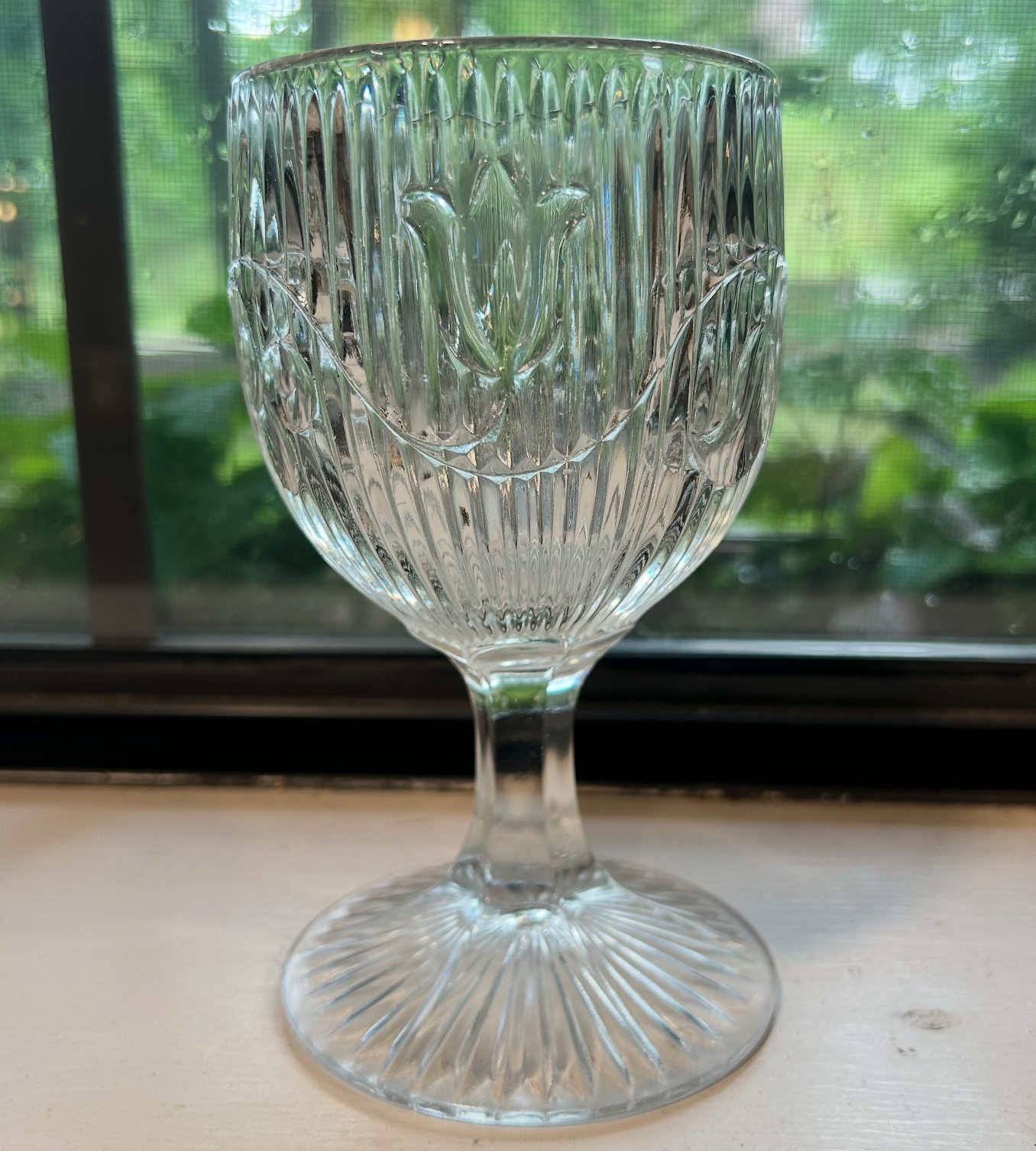
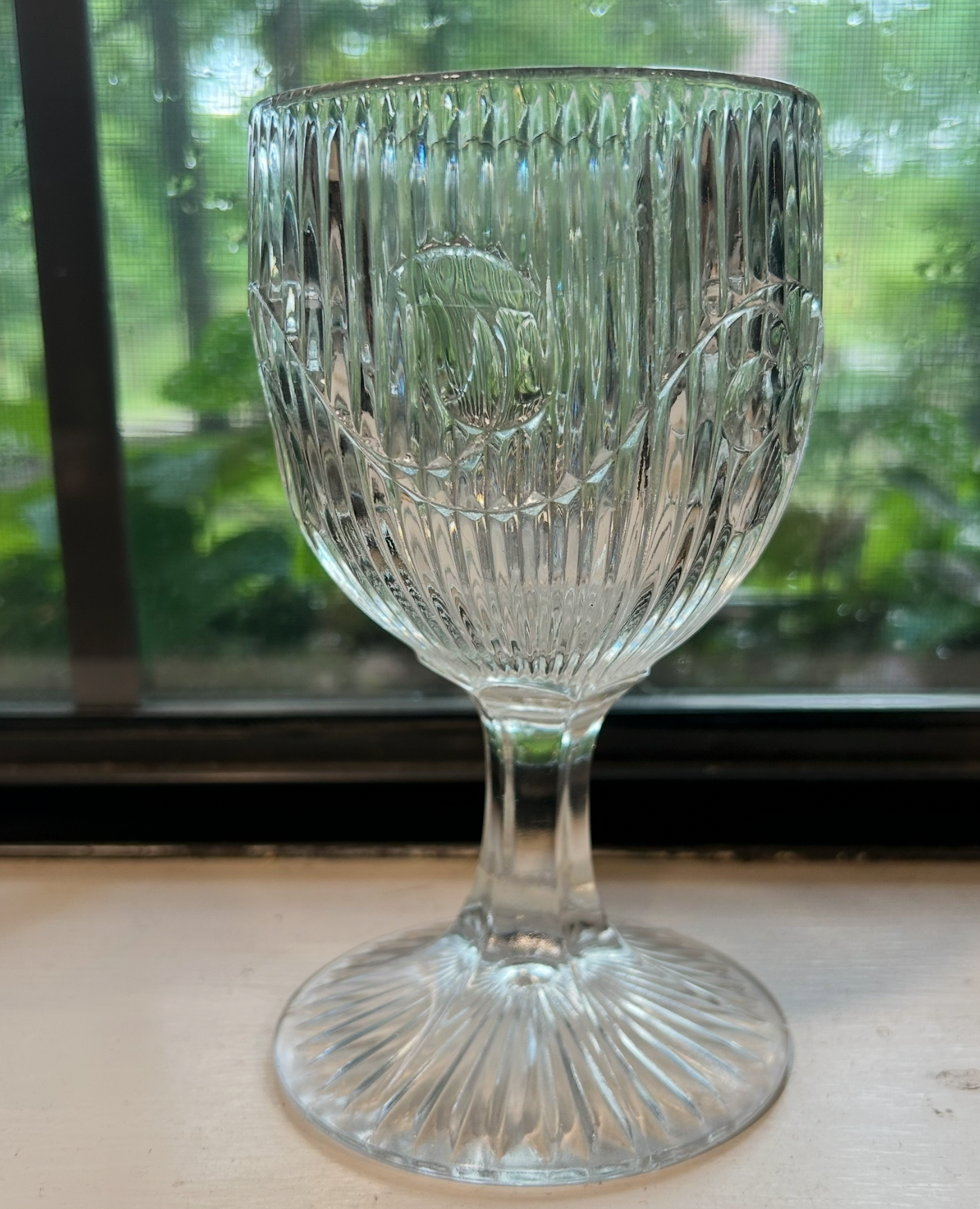
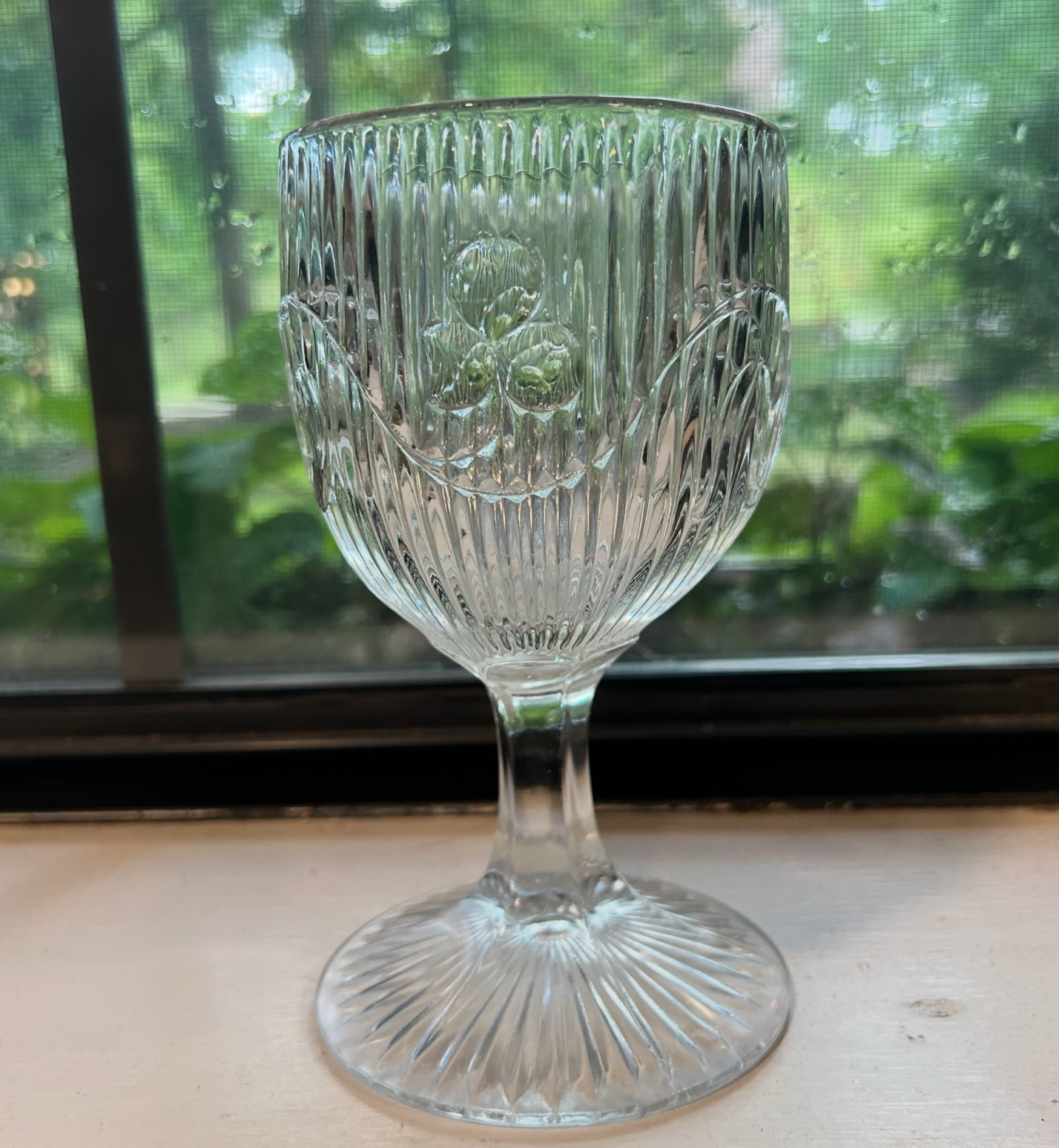
This is a pressed-glass goblet in the Bellflower pattern, one of the earliest American glass patterns made for everyday table use. It was produced somewhere between roughly 1840 and 1868, most likely across the 1840s through the 1860s. Several American factories made it, so I cannot tie this exact goblet to a single maker without more provenance. This one is the barrel-shaped version with fine ribbing, a plain stem, and a rayed (sunburst) base, which is one of the more desirable combinations.
The name
The pattern is called Bellflower, after the small bell-shaped blossoms that run around the bowl. The Pittsburgh factory that made a great deal of it, M’Kee Brothers, listed it in their price list under the initials “R.L.,” short for “Ribbed Leaf.” Bellflower and Ribbed Leaf are the same thing, then, collector’s name versus factory name.
What am I actually looking at?
Breaking the goblet into its parts:
- Bowl: barrel-shaped, meaning it curves outward and then back in like a barrel, with fine vertical ribbing. Fine rib, not coarse rib, and collectors consider fine rib the better of the two.
- Decoration: a single vine winding around the bowl, with bell-shaped blossoms and leaves alternating along it. The documented form for this pattern is a single vine, which is a defining feature.
- Stem: plain and six-sided (hexagonal) in cross-section, with no knob or bump in the middle. A useful tell is that the stem is never round.
- Base: rayed, meaning a sunburst of lines radiates out from the center on the underside of the foot.
- Glass: clear flint glass. Good examples ring like a bell when tapped, and the finest have a silvery quality.
Where it fits in the pattern
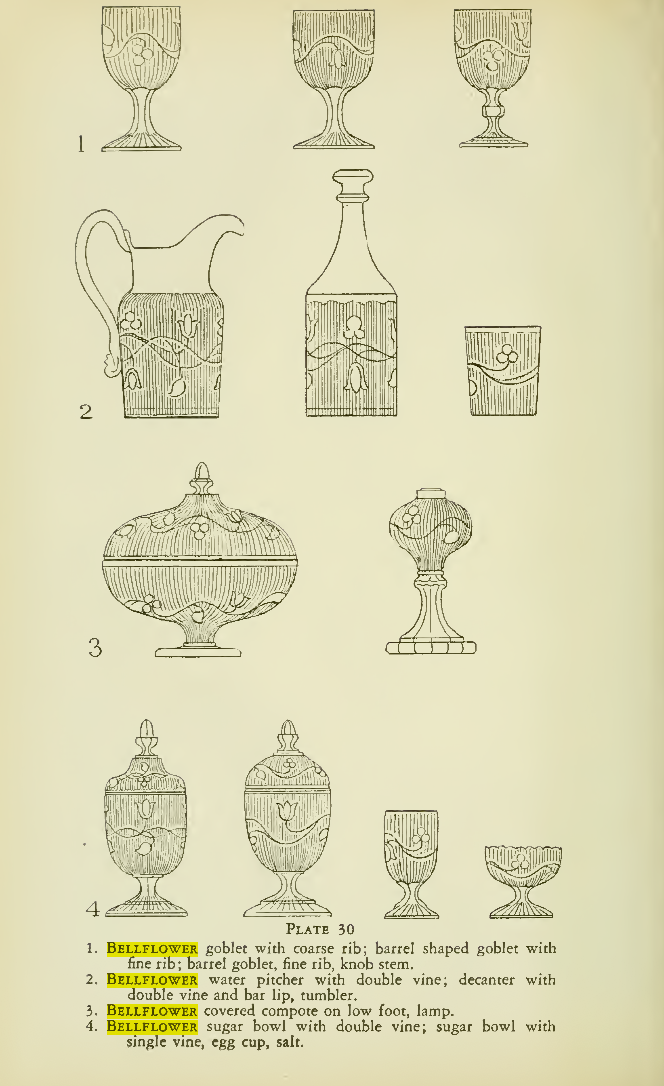
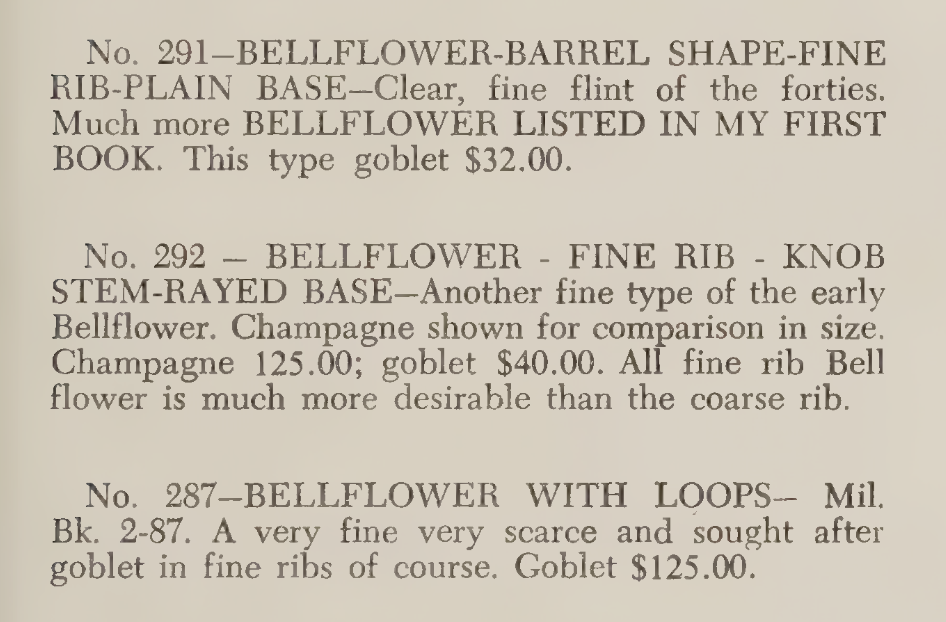
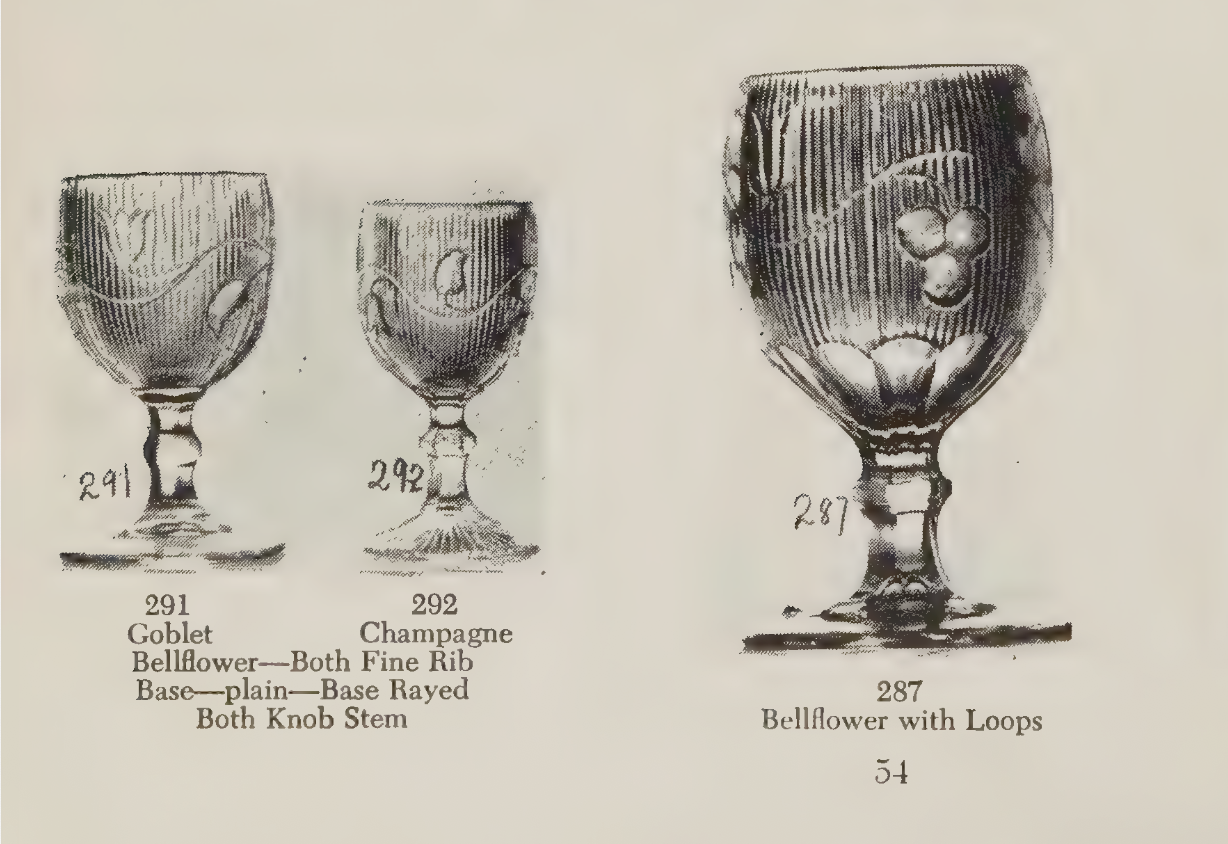
Bellflower goblets were made in several distinct shapes. Ruth Webb Lee, the main authority I am working from, sorts them into about six forms. This goblet is her “barrel shape with plain stem, fine rib” type. In her plates it is the middle goblet, the one without a knob in the stem, sitting between a coarse-rib example on one side and a fine-rib knob-stem example on the other.
The other main reference, Alice Hulett Metz, catalogues close cousins of this one, but her illustrated examples all have knob stems. This exact combination of barrel bowl, fine rib, plain stem, and rayed base is captured best by Lee’s broader category rather than by either of Metz’s specific entries.
On Lee’s Plate 30, this goblet reads as a variation of the first or second figure in the top row. Confirming which would mean measuring it and comparing it against a champagne, which is the shorter form. The remaining figures on the plate show different wares carrying the same design.
How old it is?
As mentioned, the pattern as a whole dates from about 1840 to 1868. Lee believed Bellflower was one of the very first pressed patterns made for general table use. Metz dates the fine-rib barrel type to the 1840s. The latest record of it in a factory catalogue is M’Kee Brothers’ 1868 price list. There is also a Bellflower cruet known with an 1857 patent date on its metal top, and the glass itself looks older than that fitting. Taken together, the production span runs roughly 1840 to 1868.
The pontil-mark question:
One detail helps determine how early this goblet may be. The earliest and crudest Bellflower pieces sometimes carry a pontil mark, a rough scar on the underside left from the manufacturing process before pressing machinery was fully perfected. Lee found more pontil-marked examples in Bellflower than in any other pressed-glass pattern, and she suggested that those examples probably predate 1840.
The underside of this goblet, however, is smooth rather than rough. That smooth base indicates that it is pressed glass, not a handblown piece with a true pontil mark. What appears in the close-up as a mark is more likely the impression left by the corners of the mold. The faint bubbles and slight irregularity of the base still suggest an early pressed-glass object, made before the process was fully refined.
For that reason, this goblet does not seem to belong to the very earliest pre-1840 Bellflower group. It fits better within the main production window, about 1840 to 1868, probably toward the earlier part of that range.
Who made it?
No single maker can be assigned to this goblet without provenance records. What the research does establish:
- M’Kee Brothers, Pittsburgh, Pennsylvania, advertised many Bellflower table pieces in their 1868 price list.
- Boston & Sandwich Glass Company, Sandwich, Massachusetts, is documented as a maker.
- New England Glass Company, Cambridge, Massachusetts, possibly made it too, though there is no firm record.
- Many other factories around the country copied and produced Bellflower for years.
That last point explains why so many small variations exist. Each factory tweaked minor details, so the pattern has more variants than almost any pattern that came after it.
What the glass quality tells me:
Quality varies from piece to piece. Some Bellflower is silvery and fine, like the early “lace glass” associated with Boston & Sandwich. Other pieces are duller, though most will still ring like a bell when tapped. A worn factory mold sometimes left the design faint in the rays, and once in a while a piece shows a faint purple (amethystine) tint. Across the board, fine rib is considered more desirable than coarse rib.
Flint glass and lead
The following comes from sources outside Lee and Metz. This goblet is flint glass, which means it contains lead. The lead accounts for its weight and for the bell-like ring it gives when tapped. Leaded flint glass largely disappeared from American pressed tableware after about 1864, when wartime demand drew lead toward munitions and a cheaper lime-glass formula came into use. That shift coincides with the close of Bellflower production and supports placing this goblet within the 1840 to 1868 window.
A note on lead content and safe handling
This goblet is flint glass and therefore contains lead. Leaded glass can release small amounts of lead into a drink, and that risk rises with acidic or hot contents and with prolonged contact, so the piece is best kept for display and study rather than regular use. Occasional, brief use by a healthy adult carries low risk, but liquids should never be stored in it, it should never go through a dishwasher or hold anything heated, and it should be kept away from children and anyone pregnant or nursing. Any chip or crack should retire it from use entirely. Anyone wanting certainty can test the piece with a lead kit rated for glassware. This note is general guidance and not medical advice.
What it is worth, with a large caveat
Pricing here gives only a relative sense of value, not a current market figure. Alice Hulett Metz priced these forms in her 1978 Book II at $32.00 for the plain-base goblet (No. 291), $40.00 for the rayed-base goblet (No. 292), and $125.00 for the scarce Bellflower with Loops (No. 287). Adjusted for inflation, those figures come to roughly $160, $205, and $640 in today’s money, though that conversion reflects purchasing power and not collectible market value. The rayed base, which this goblet has, was priced above the plain base, a sign of its greater desirability. Establishing what this goblet is actually worth now would require current or recent auction records and a specialist.
Goblet, not champagne
Bellflower champagnes look a great deal like the goblets, which can cause confusion. Champagnes run shorter, roughly 5¼ to 5⅝ inches, with shallower bowls. Goblets are taller with deeper bowls. By its proportions, this is a goblet.
One more thing worth knowing
Bellflower was made in an enormous range of forms, from plates and pickle dishes to lamps and whiskey tumblers. That breadth is part of why it stands as such a landmark early American pattern, and why a single goblet like this one sits inside a very large family of related wares.
The afterlife of a lost object
Seen through the lens of this collective, a single Bellflower goblet becomes more than a date and a pattern name.
Consider the material first. The lead that gives this glass its weight and its bell-clear voice is the same metal that, once the war came, was drawn toward bullets and shot. The very brilliance of the object shares a substance with the machinery of mass death that was about to arrive. Flint glass itself did not survive that moment. The cheaper lime formula of 1864 displaced it, and leaded tableware faded from American tables. The goblet sits on a threshold, then, a domestic vessel from the last years before the war, made of the very metal the war would soon draw into its weapons, and belonging to a way of making glass that those same years effectively ended.
There is also the matter of the set. Goblets like this were never made alone. They were produced as services, sold by the dozen, set out for ordinary suppers and for the gatherings that marked a household’s milestones. This one has outlived all of that. Its companions are broken or scattered, the table is gone, and the hands that lifted it are long dead. What remains is a single survivor, lost in the sense that it has been severed from the whole it once completed.
The lead that once made it useful is now the reason it cannot be used. It has been retired from drinking and kept for display, which is its own kind of afterlife. The object persists, but in a changed condition, carried forward as a witness rather than a tool. It holds the memory of a vanished set, a vanished table, and a vanished way of living, and it carries that memory precisely because the people and the occasions it served cannot. That is the work this goblet does now, and it is the reason a single orphaned piece is worth keeping and worth looking at closely.
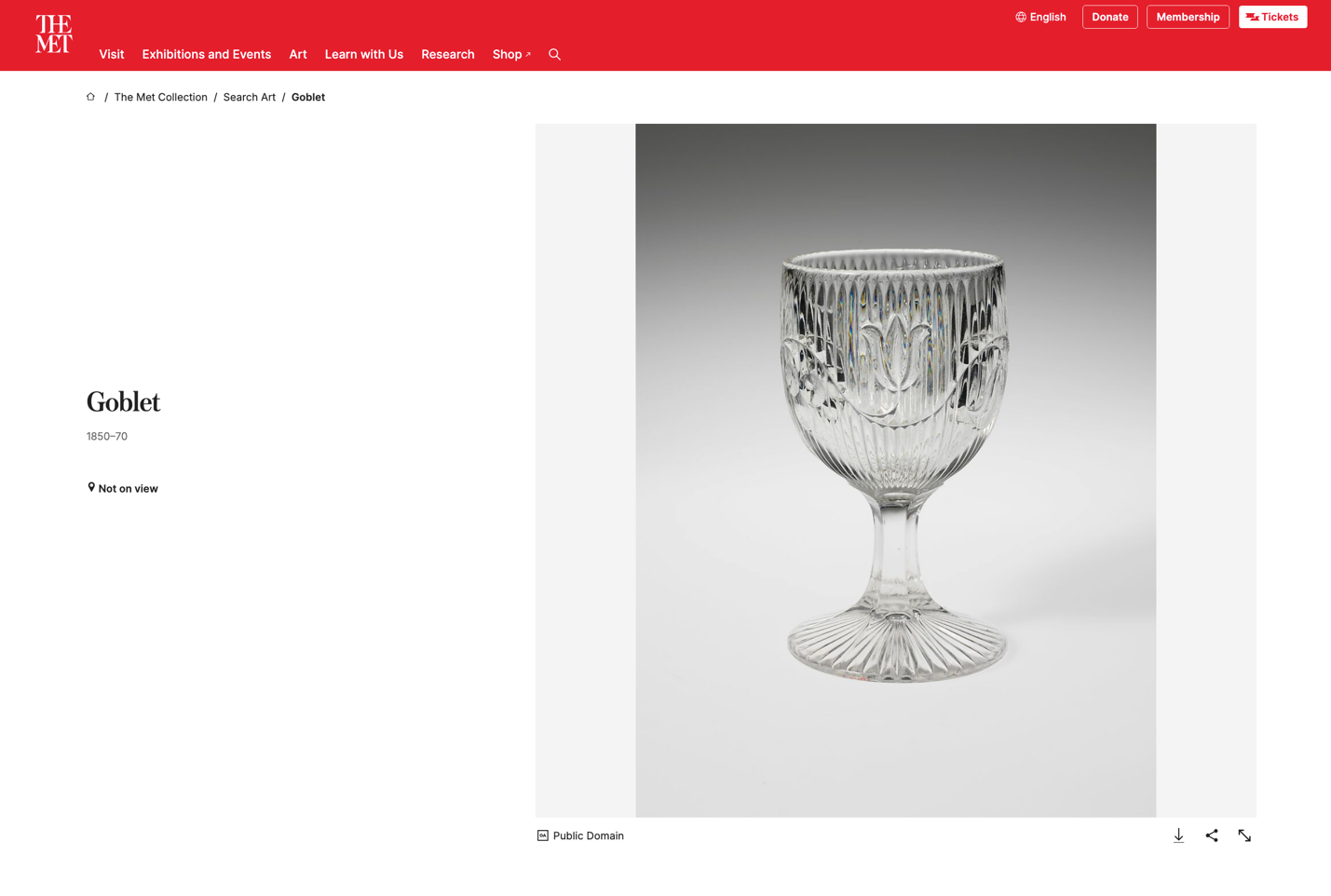
The Metropolitan Museum of Art also holds one of these goblets, dated 1850 to 1870 and cataloged simply as pressed glass. Its record carries almost nothing, only that the museum received it in 1979 as a gift from Anita G. Muller, and it is not on view. Even in one of the largest collections in the world, the form arrives stripped of its history, kept but not shown, named for its donor alone.
https://www.metmuseum.org/art/collection/search/4085
Sources
The factual catalogue research here rests on two references:
- Ruth Webb Lee, Early American Pressed Glass (1931, later enlarged editions), Chapter IV, “Ribbed Group.”[Images are from Ruth Webb Lee, Handbook of Early American Pressed Glass Patterns (Framingham Centre, Mass.: R. W. Lee, 1936), Plate 30.]
- Alice Hulett Metz, Much More Early American Pattern Glass, Book II (1978, values revised 2000). [Images are from this book.]
The note on lead, the wartime transition to lime glass, and the safe-handling guidance draw on general glass scholarship and public-health sources outside Lee and Metz.