Probably French, late Rococo Revival with Art Nouveau influence, c. 1880–1910 · Filed June 2026
The Object
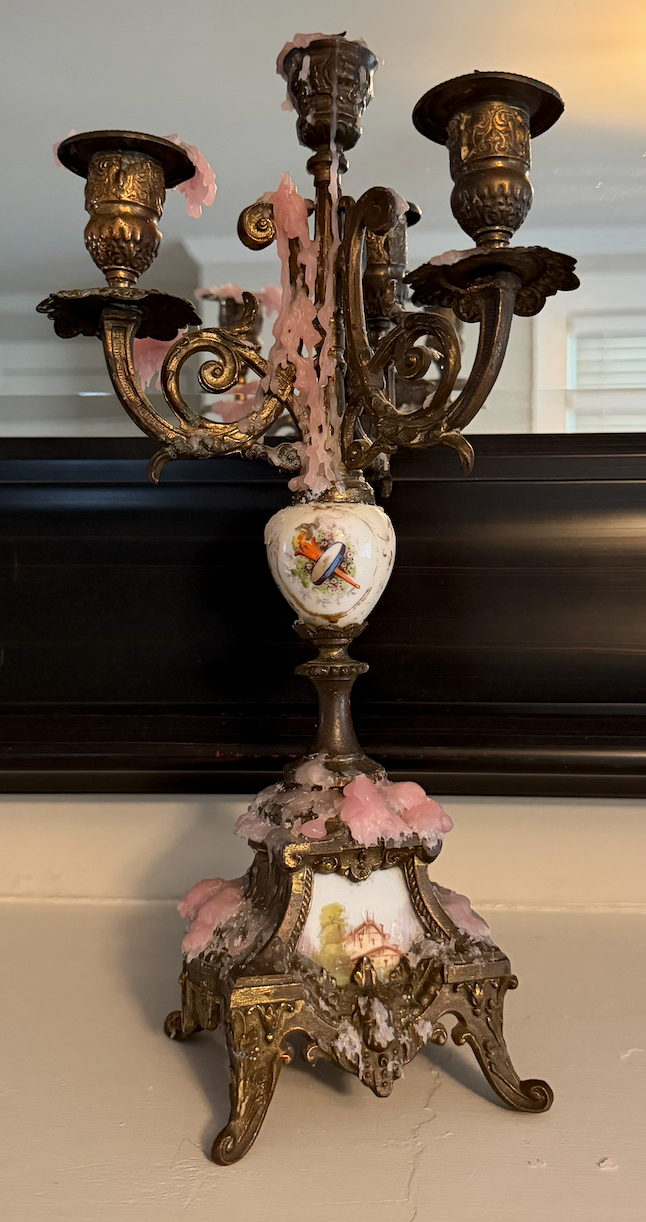
A four-light candelabrum of ornate cast metal mounts surrounding painted porcelain panels and a central porcelain urn, the whole strongly Rococo Revival in character, with scrolling foliate arms and elaborate ornament. It measures approximately 14 1/4 inches (36.2 cm) high, about 8 inches (20.3 cm) across the outer candle arms, and roughly 5 1/2 inches (14 cm) across the base, weighing about 3 pounds (1.4 kg). The base carries what appear to be hand-painted pastoral landscape scenes on porcelain reserves, a couple of houses, and a tree to the left. There is some loss of gilt, and now a film of pink wax still clings to the candle holders (the only candles we could find during the blackout after Hurricane Helene).
What the Research Yielded
I posted the candelabrum to a collectors’ forum in early June 2026, and two anonymous respondents moved the file forward, even if they could not close it.
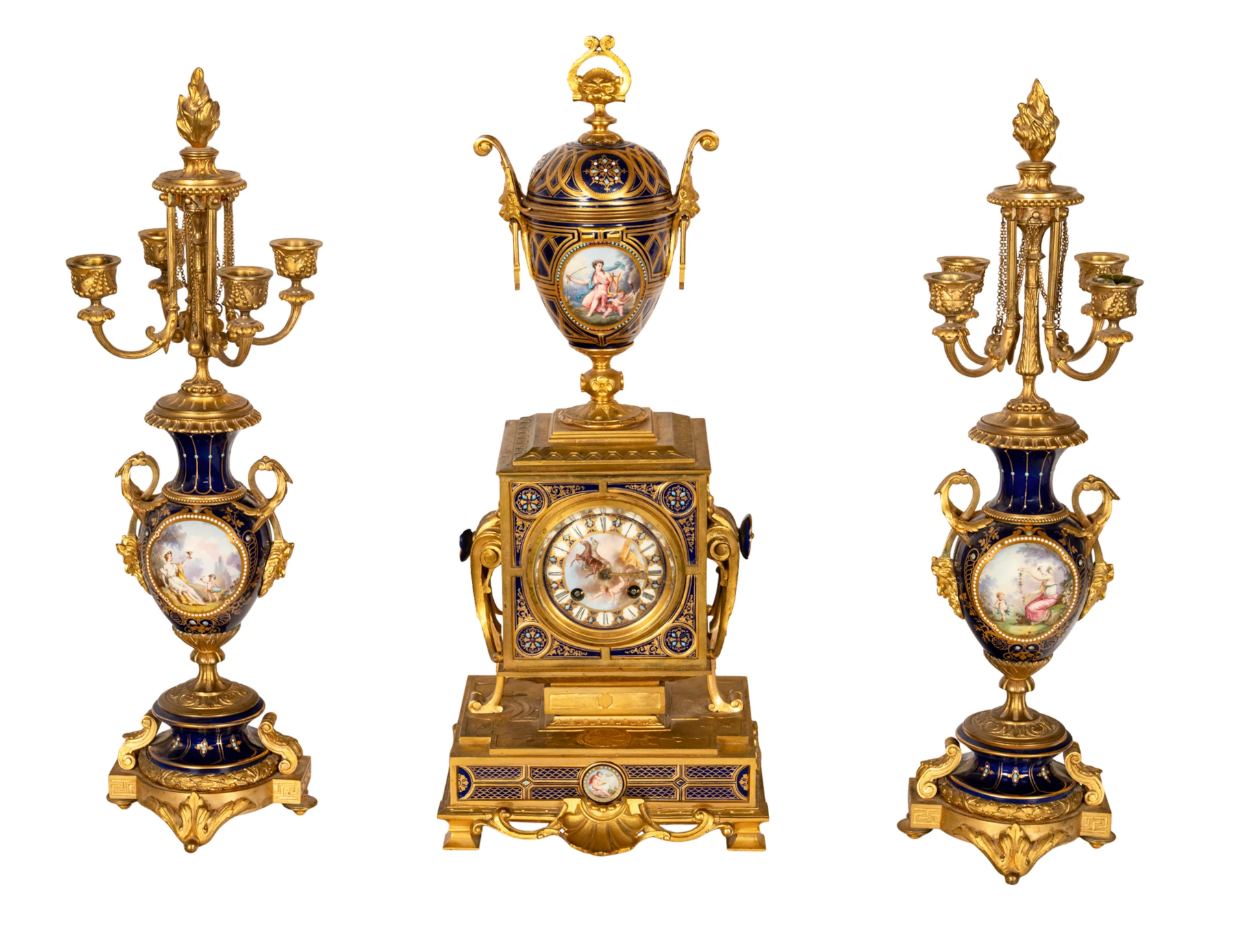
The first confirmed my dating instinct: the piece reads as the terminal phase of the Rococo Revival, coupled with Art Nouveau influences, so late nineteenth century into the turn of the twentieth, as I had suspected. More usefully, they identified its original context; this candelabrum would not have stood alone. It was almost certainly one of a pair, made to flank a clock as part of a three-piece garniture set. The comparable they offered is an antique French ormolu and Sèvres porcelain three-piece clock garniture of circa 1870, by Brocot & Delettrez of Paris, currently with Bloomsbury Fine Art & Antiques, somewhat earlier than mine, grander, and fully attributed, but the same logic of object: cobalt porcelain panels in gilt bronze mounts, candelabra built as satellites to a clock. My candelabrum, then, is a fragment of a set. Its clock and its twin are elsewhere, or nowhere.
The same respondent noted that the absence of decorative detail on the back of the porcelain suggests the panels were hand-painted rather than transfer-printed, and that, together with the gilt losses, this example is quite likely unique. A factory mark, if one exists at all, may be stamped on the individual candle-holder inserts (if original ones survive) or hidden somewhere within the assembly, recoverable only by dismantling the candelabrum.
The Iconography
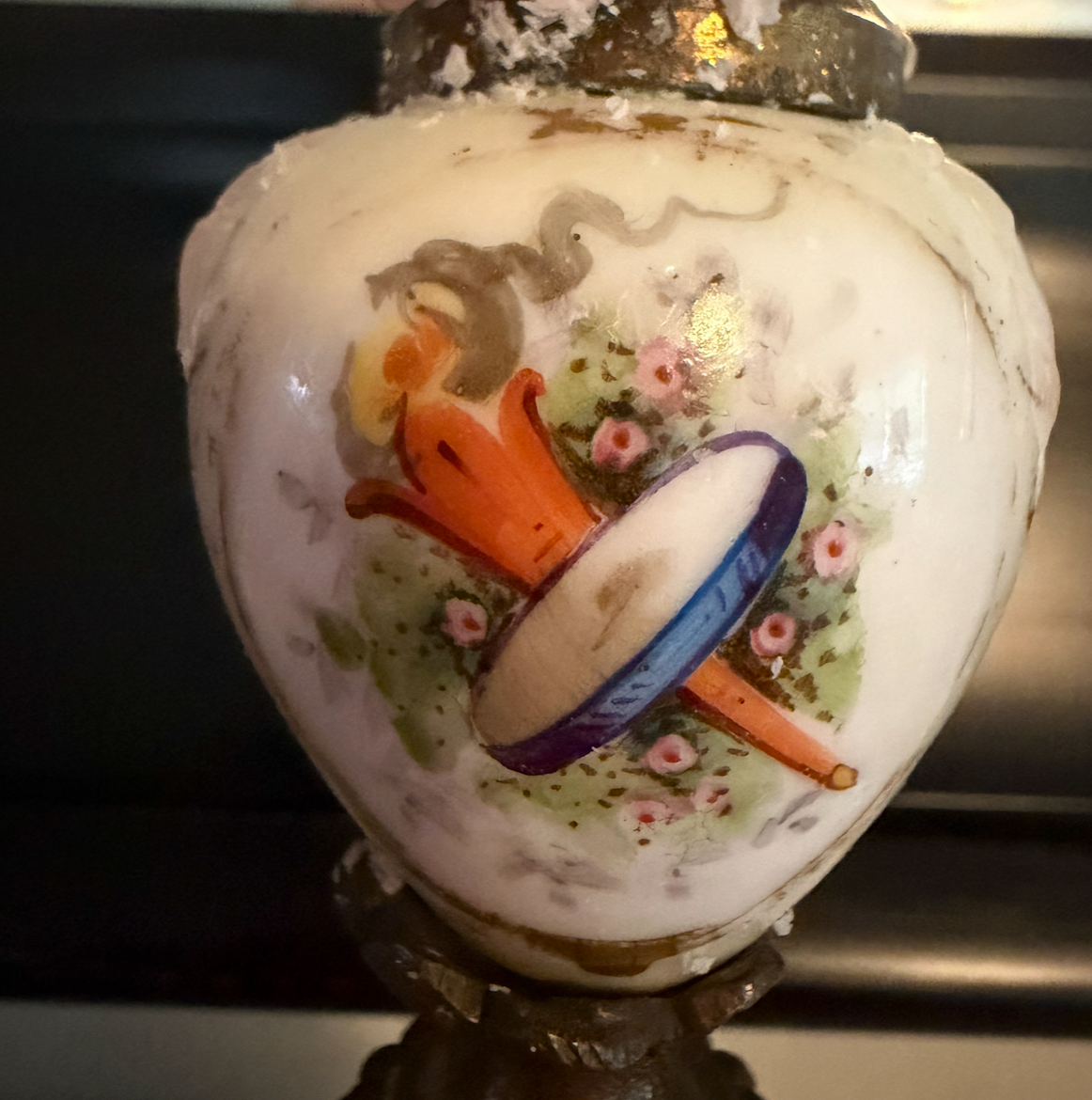
The painted decoration is what first held me. The porcelain urn bears a burning torch, flames and smoke visible, beside a circular object I take to be a mirror because there is a faint painted reflection within it, in which I think I can make out a tree and a grassy foreground. The second respondent suggested the torch-and-mirror combination may belong to the truth/vanity allegorical tradition, a common theme in European decorative arts of the period. I have not yet been able to confirm a specific source or emblematic precedent for this exact pairing, and the motif remains the most promising open thread in the file.
Status
Unattributed. No maker's marks found. Country of origin unproven, French construction seems most likely on style, though German, Austrian, or Bohemian manufacture has not been ruled out. Dating of c. 1880–1910 supported but not documented. Original garniture context established in principle; the companion pieces unlocated.
For now, this remains a lost object, not in the sense of being missing, since it sits on my mantelpiece, but in the sense that its history has come loose from it. The file stays open in this Fragments and Notes Room. I may come back for it.
Sources: original research post and responses, online collectors' forum (Reddit), June 2026; comparable garniture, Bloomsbury Fine Art & Antiques, “Antique French Ormolu & Sevres Porcelain 3 Piece Clock Candelabra Garniture 1870” (Brocot & Delettrez, Paris). https://tinyurl.com/4f8b2u7j